
According to the annual statements of the electricity grid operators, €16.5 billion in subsidies flowed to operators of wind and solar power plants in 2025, even though electricity had virtually no market value during many hours, was sometimes given away for free, or could not be generated at all due to grid congestion. The root cause is the support system with fixed feed-in tariffs over 20 years, which also pays out when too much solar and wind power is simultaneously fed into the grid at midday. The risk, therefore, lies in the oversupply during periods of sunshine and wind, while expensive imports become necessary at other times. The consequences are borne by tenants, drivers, and businesses, who are additionally burdened by CO2 prices, heating costs, fuel prices, and high electricity bills. At the same time, political conflict is intensifying because reform proposals immediately encounter resistance from the Social Democratic Party (SPD) and the Green Party. (netztransparenz: 10.03.26)
How the subsidy system unlocks billions for surplus electricity
Operators of wind and solar power plants receive between 6 and 12 cents per kilowatt-hour, depending on the plant. If the market price falls below this amount, the government compensates for the difference. However, this happens particularly often when large amounts of solar and wind power are fed into the grid simultaneously at midday.
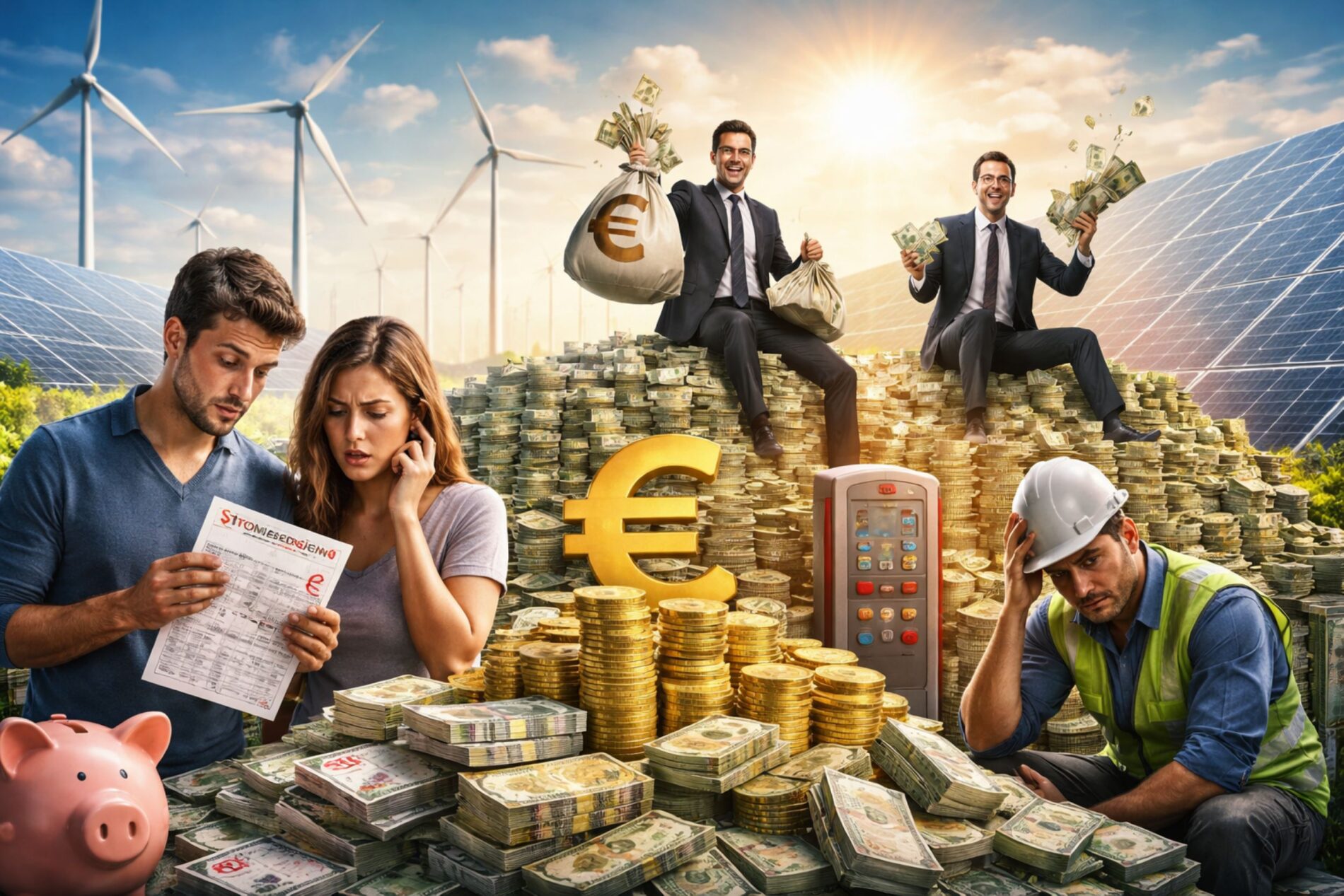
Then the electricity price drops towards zero, while the fixed feed-in tariff continues. The government is thus subsidizing electricity that is hardly needed at that moment. As a result, some of the surplus ends up abroad, or grid operators intervene and curtail production. Even then, money continues to flow, because operators receive 95 percent of the feed-in tariff even for electricity they don’t actually generate under these circumstances.
Extreme price fluctuations exacerbate the burden
When the sun isn’t shining and the wind isn’t blowing, the situation quickly changes. Germany then has to import expensive electricity, while the price can easily rise to 20 to 40 cents per kilowatt-hour. This illustrates a stark contrast, as hours of worthless surplus electricity are followed by periods of scarce and expensive supply.
The costs are borne not only by private households, but also by landlords, drivers, and industry. Critics therefore speak of a redistribution of billions of euros in favor of investors with deep pockets in wind and solar farms. Economics Minister Katherina Reiche is therefore considering adjustments. However, the Social Democratic Party (SPD) and the Green Party immediately voiced their opposition. Nina Scheer warned that a reform would “massively slow down the expansion of photovoltaics.” Katrin Uhlig even spoke of an “attack on the successful model of the energy transition.”
Nuclear power, coal, and fracking are back in the spotlight
It is precisely because of these costs that pressure on energy policy is growing. Critics are therefore calling for a new debate on the continued operation of coal-fired power plants, the lifting of Germany’s 2017 fracking ban, and the end of the nuclear energy ban. Their central argument is that Germany needs reliable power output, not just weather-dependent feed-in.
They point to previous political responses to supply crises. After the oil crises, Helmut Schmidt relied on a massive expansion of nuclear energy, while Friedrich Merz appears contradictory today. On the one hand, at the New Year’s reception for industry in Halle in January 2026, Merz said that the phase-out of nuclear energy had been “a serious strategic error” and that the energy transition was “the most expensive and inefficient in the world.” On the other hand, regarding the current situation, he stated: “I regret this, but it is the way it is, and we are now focusing on the energy policy we have.” Even Ursula von der Leyen now describes the move away from nuclear power as a strategic mistake, although she supported the phase-out in 2011 as a member of the German government. Critics see it as a symbol of an energy policy that generates high costs while simultaneously weakening Germany’s industrial base.