
A small rodent, likely a mouse, has brought an entire wind farm in Hilchenbach to a standstill. The Rothaarwind 1 wind farm, consisting of five turbines, has been shut down in the Siegen-Wittgenstein district since mid-January because a short circuit damaged a substation. The grid operator cites a small rodent as the culprit and suspects a mouse. The operator is already anticipating losses of around €100,000. (wdr: 29.01.26)
Short circuit at substation halts power supply
In mid-January, a rodent gained access to a substation in Hilchenbach. A short circuit occurred, damaging the substation and interrupting the wind farm’s grid connection. The animal was electrocuted and died. As a result of the short circuit, the wind turbines are currently unable to distribute their electricity.
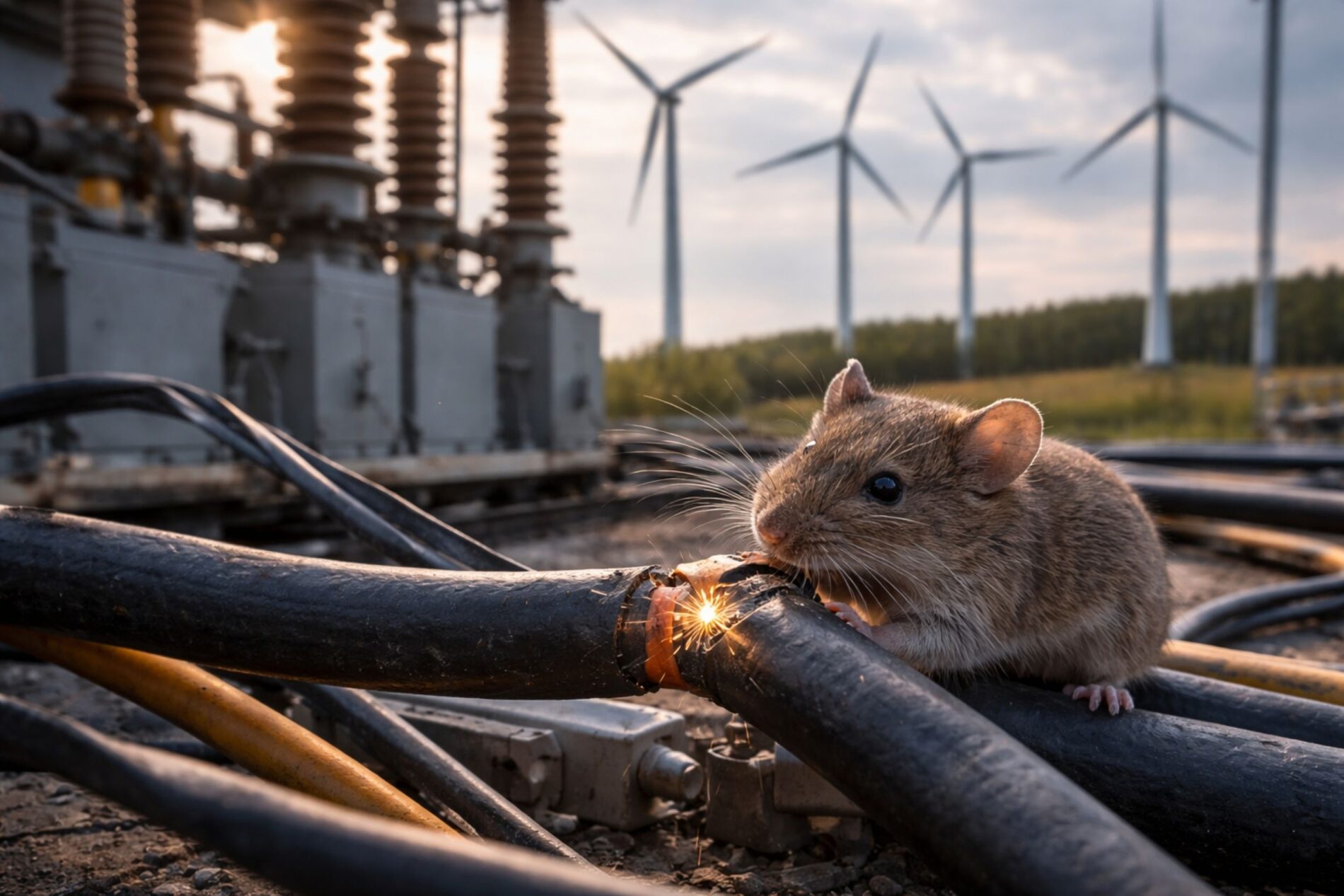
The grid operator Westnetz remains cautious in its assessment. Henning Drees says: “We can only speak of small animals; with the remains, it’s impossible to determine exactly what it is.” Nevertheless, a mouse is considered plausible, as such rodents frequently enter buildings. There is no definitive confirmation yet.
Five turbines affected – wind farm unable to generate electricity
Five wind turbines, each with a capacity of two megawatts, have failed. This means that not just a single turbine, but the entire power supply of the park is down. This demonstrates how heavily a wind farm depends on a few key technical components. As soon as the substation fails, the generation also ceases.
Operator Günter Pulte estimates the current losses at approximately €100,000. “The exact damage can only be assessed after the system is back online,” he told WDR. To his knowledge, end customers are not affected because the supply from other sources remains stable.
Repairs take two to three weeks – the damage increases with each day
Westnetz anticipates a repair period of two to three weeks. During this time, the wind farm will remain disconnected from the grid, even if there is sufficient wind. Therefore, the financial damage increases primarily over time, as every hour of downtime means lost feed-in and lost revenue.
At the same time, work on substations is complex. Safety is paramount, and switchgear must be thoroughly inspected. Therefore, the process cannot be accelerated indefinitely, even though the pressure is high.
Protection against animals is in place – but an open access point can be enough
Substations are normally secured against intruders. Westnetz points to traps and protective measures designed to keep small animals out. Nevertheless, even minor oversights in everyday life are enough. Drees describes it this way: “All it takes is for someone to leave a door open to go back to their car, and a rodent scampers in.”
The incident also shows how unspectacularly a chain of events can begin that has major consequences. A single animal reaches a sensitive area, and suddenly an entire wind farm is shut down. Especially with critical infrastructure, such details have a disproportionate impact.
Who pays is still undecided – communication between the parties is ongoing
It has not yet been decided who will cover the damage. Westnetz explains that the operator can claim damages, but this will be examined on a case-by-case basis. Henning Drees adds: “This is a case-by-case decision. It cannot be said categorically whether the grid operator is responsible.”
Pulte nevertheless assesses the cooperation positively. “Communication is good and friendly,” he wrote in response to an inquiry. Westnetz is making every effort to repair the damage quickly. However, one thing is already certain: a small rodent, possibly a mouse, was likely enough to cripple an entire wind farm.