
At Oak Ridge National Laboratory in the USA, a research team has presented a process that converts polyethylene plastic waste into fuel at temperatures below 200 degrees Celsius. The study, published in the “Journal of the American Chemical Society,” utilizes a molten salt solution containing aluminum chloride as the reaction environment. The starting point is a dual problem: large quantities of plastic end up in landfills or incinerators, while the demand for fuels remains high and crude oil is expensive and politically sensitive. The decisive advantage of this method lies in its significantly lower energy consumption compared to conventional processes. However, the greatest risk factor remains moisture, as the molten salt solution is sensitive to water. According to the researchers, approximately 60 percent of the resulting product is gasoline-like. Therefore, the process could become economically viable for transportation and industry. (pubs.acs: 07.04.26)
Plastic Waste as a Raw Material for Gasoline and Diesel
The new approach differs from previous methods primarily in terms of temperature. Many known methods for converting plastic into fuel operate at 450 to 500 degrees Celsius. With the new process, less than 200 degrees is sufficient. Therefore, energy consumption is significantly reduced, and the technology should also be easier to scale up to larger plants.
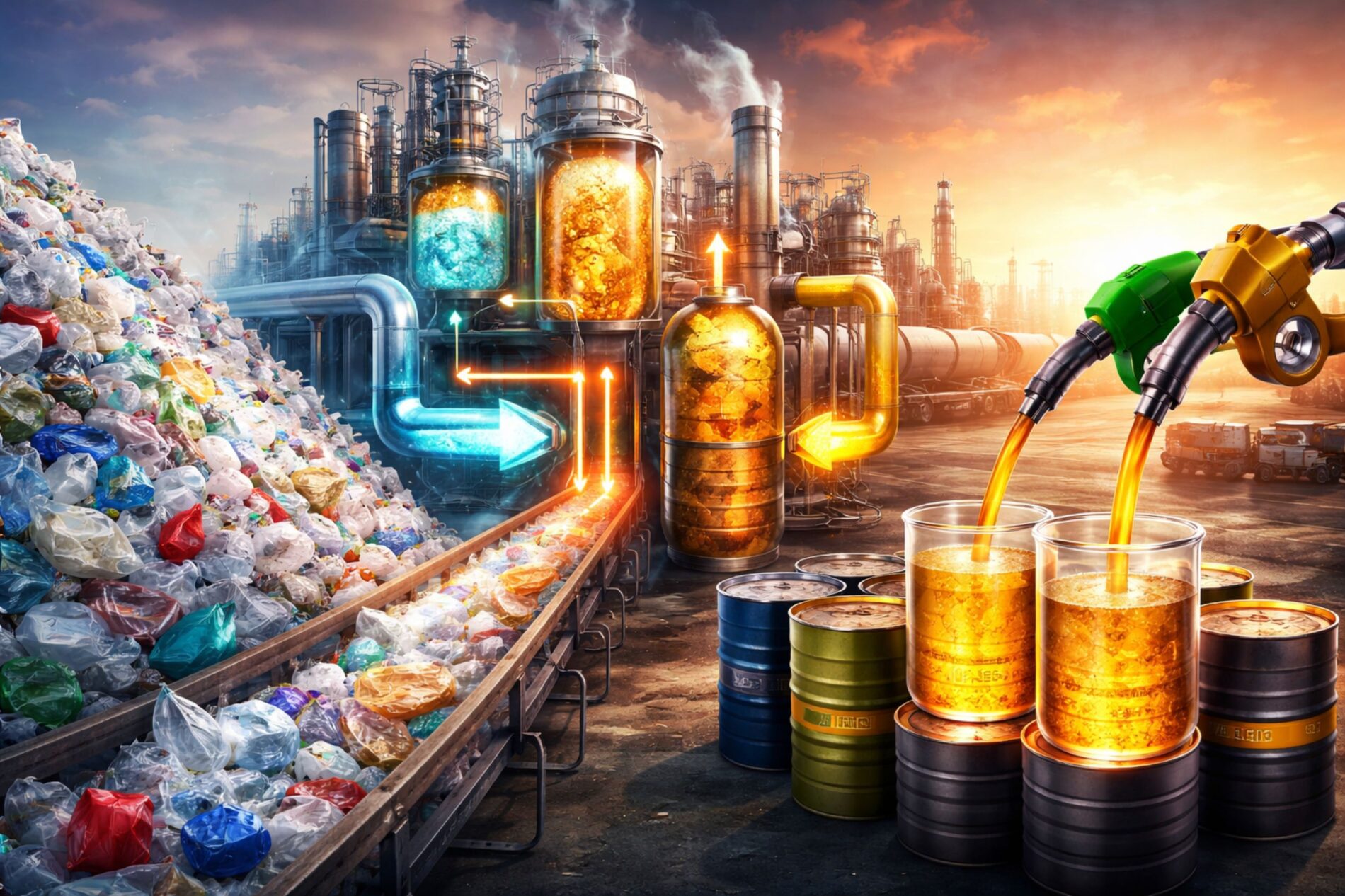
The focus is on polyethylene, which is found in packaging, bags, and many everyday products. This plastic is produced in very large quantities and is therefore readily available as a raw material. This can be significant for industrialized countries with high plastic consumption. The new process would make it possible to use plastic waste not as a disposal resource, but as a raw material for fuels.
Fewer Additives, but One Open Problem Remains
A key advantage of the process lies in its low material requirements. The reaction takes place in a molten salt containing aluminum chloride and requires neither precious metal catalysts nor organic solvents or external hydrogen. Chemist Zhenzhen Yang explains: “Unlike conventional methods for converting plastics into fuel, the new process required neither precious metal catalysts nor organic solvents or external hydrogen.”
Reactive sites form in the molten salt, where long plastic chains break down. This creates smaller molecules that, depending on their structure, yield substances more similar to gasoline or diesel. First author Liqi Qiu says: “We have developed an efficient and selective conversion of polyethylene to gasoline.” Around 60 percent of the products are gasoline-like, making the approach economically attractive. The researchers monitored the reaction using neutron scattering, isotopic labeling, and spectroscopic methods, while one problem remains unsolved: The molten salt is sensitive to moisture. Therefore, the team is working on more stable systems so that plastic waste can be reliably turned into fuel on an industrial scale in the future.