Austria will introduce new network fees from 2027, which can put a financial burden on owners of electric cars and heat pumps in particular. The regulatory authority E-Control decided on a fundamental reform of electricity network tariffs on October 12, 2026. In the future, in addition to the amount of electricity used, the highest average power consumption within 15 minutes of a month will also count. For example, if you charge your electric car while the heat pump and other household appliances are running at the same time, this will cause a high power peak. This can increase the network fees for the entire month, even though the household does not use more electricity overall. This means that the simultaneous use of powerful electrical devices becomes an additional cost factor. The background is the increasing demands on the power grids due to increasing electrification.
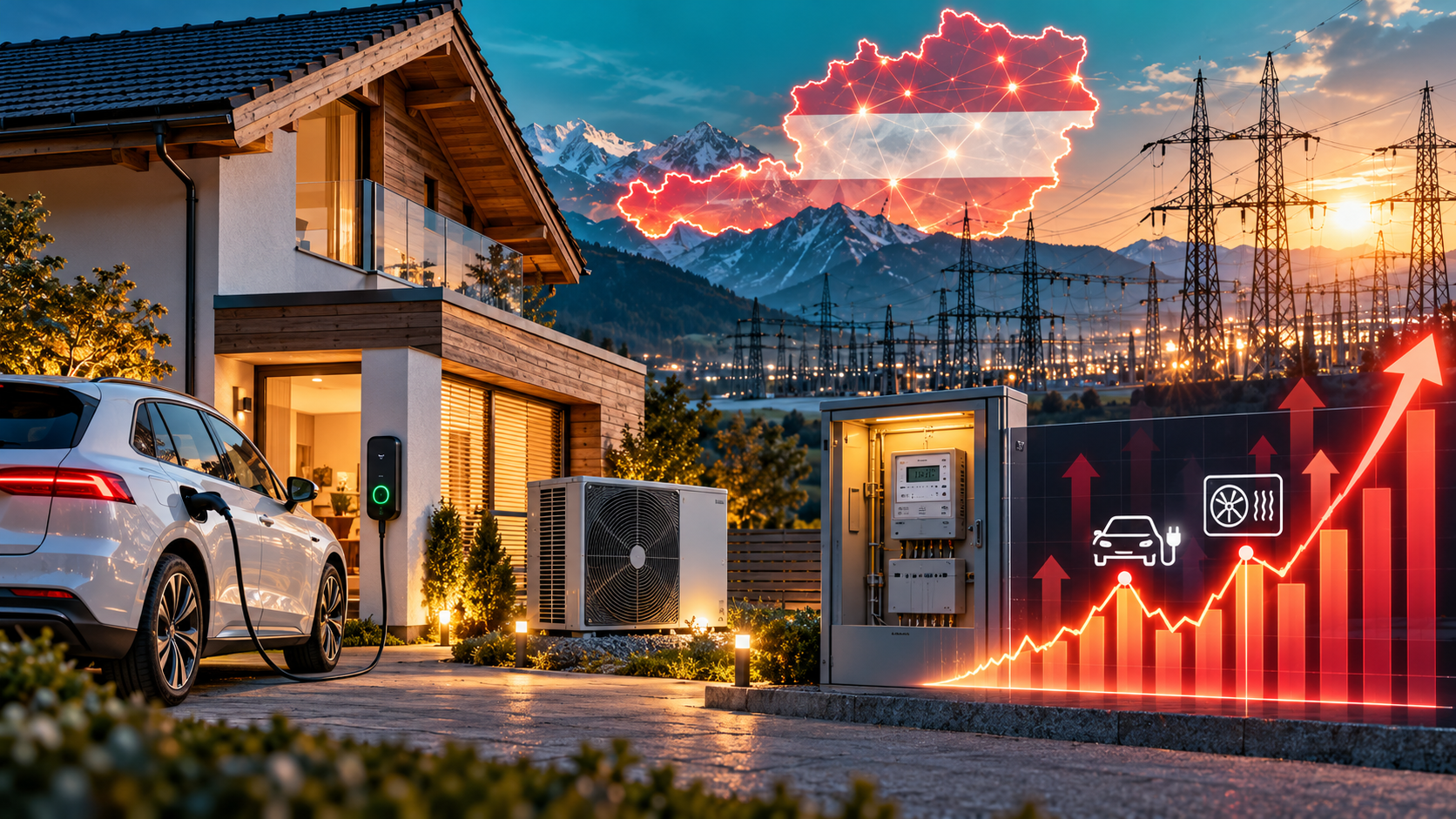
Image: AI-generated
New grid tariffs turn high electricity demand peaks into a cost factor
Previously, Austrian grid tariffs for households were based primarily on the number of kilowatt-hours consumed. In the future, billing will also take into account the highest average power demand recorded over a 15-minute interval. Smart electricity meters will be used to capture these consumption values. The peak 15-minute power demand for a given month will then influence the capacity-based component of the grid tariff for that month. Consequently, even a single, prolonged charging session could lead to an increase in monthly grid charges.
This issue is particularly pronounced in the case of electric vehicles and heat pumps. A standard wallbox charges at 11 kilowatts, which already places a significant demand on the grid. If a heat pump is running at the same time, the total power demand increases further. Assuming an electrical power demand of 9 kilowatts for the heat pump, the combined load could reach 20 kilowatts. However, not all heat pumps reach such levels; the actual electrical power demand and the simultaneous use of other appliances are the decisive factors.
Grid charges hit the very electrification that is being encouraged
For years, Austrian energy policy has promoted the transition to electric vehicles and electric heating systems. Now, those same consumers are being asked to limit their power consumption to prevent the electricity grids from becoming overloaded. This reveals a significant contradiction between policy goals and existing grid capacity; electrification not only increases annual electricity demand but also raises the peak power required at any given time. Consequently, households are increasingly forced to adapt their consumption habits to the technical limits of the grid.
E-Control, for instance, recommends charging electric vehicles at four kilowatts rather than eleven. However, this significantly extends charging times—a recommendation that may not be practical for those who travel long distances daily. At the same time, heat pumps are expected to operate as steadily as possible to avoid large power spikes. These new grid charges effectively shift some of the responsibility for grid load onto consumers. Of particular concern is the fact that the specific financial impact remains unknown.
Higher fees for power spikes—exact figures yet to be determined
The transition will begin on January 1, 2027, and must be fully implemented by July 1, 2028. Initially, the capacity-based component of the charges is set to reach 40 percent. In the long term, the regulatory authority aims for an even split between consumption-based and capacity-based pricing. Furthermore, a frequently mentioned threshold of ten kilowatts relates to the classification of grid connection capacity; however, this is not a blanket exemption limit above which a fixed penalty is automatically applied. The final tariff structures are not expected to be determined until December 2026.
Meanwhile, Austria is planning new incentives to encourage the shifting of electricity consumption. Starting in October 2027, a reduced grid usage tariff is set to apply during the winter months between 11 p.m. and 5 a.m. Furthermore, customers who opt for flexible grid usage can receive significant discounts; in exchange, they must agree—under certain conditions—to temporarily limit their power consumption. E-Control anticipates that lower peak loads will lead to a long-term reduction in annual grid costs of approximately 300 million euros. However, these are projected savings rather than proven cost reductions.
Expansion of the power grid remains necessary despite new charges
While tariff reform can lead to better utilization of existing grid capacity, it is no substitute for expanding the grid in line with actual requirements. After all, the demand for reliably available power is rising due to the proliferation of electric vehicles, heat pumps, and other electrical applications. Consequently, those who require higher connection capacities must continue to have access to the necessary grid infrastructure. It would be particularly problematic if consumers were to pay additional charges while essential investments continue to lag behind actual needs.
Political responsibility, therefore, does not end with the introduction of new billing models. Austria must ensure that the electrification process is supported by sufficient generation and grid capacity. Otherwise, consumers will end up paying for an energy transition for which the necessary technical foundations have not been fully established. Although the regulatory authority, E-Control, emphasizes that households without high-demand appliances are unlikely to face significant additional costs, the actual financial burden for owners of electric vehicles and heat pumps will increasingly depend on their individual usage patterns. Whether the reform will ultimately prove to be fairer remains to be seen once the final tariffs are set and the subsequent electricity bills arrive.