
Preparations are underway to launch Germany’s fourth state-managed liquefied natural gas (LNG) import terminal following a long delay. The state-owned operator, Deutsche Energy Terminal (DET), announced on Wednesday that the terminal vessel Energos Force had docked at the Stade-Bützfleth industrial port on Tuesday. Because the facility’s launch had been delayed, the vessel had been chartered to Jordan in the interim.
Federal Minister for Economic Affairs Katherina Reiche (CDU) welcomed the imminent start of natural gas imports. “The arrival of the Energos Force in Stade makes it clear what security of supply means in practice,” she stated. Starting in November, the vessel could “help reliably supply millions of households with energy.”
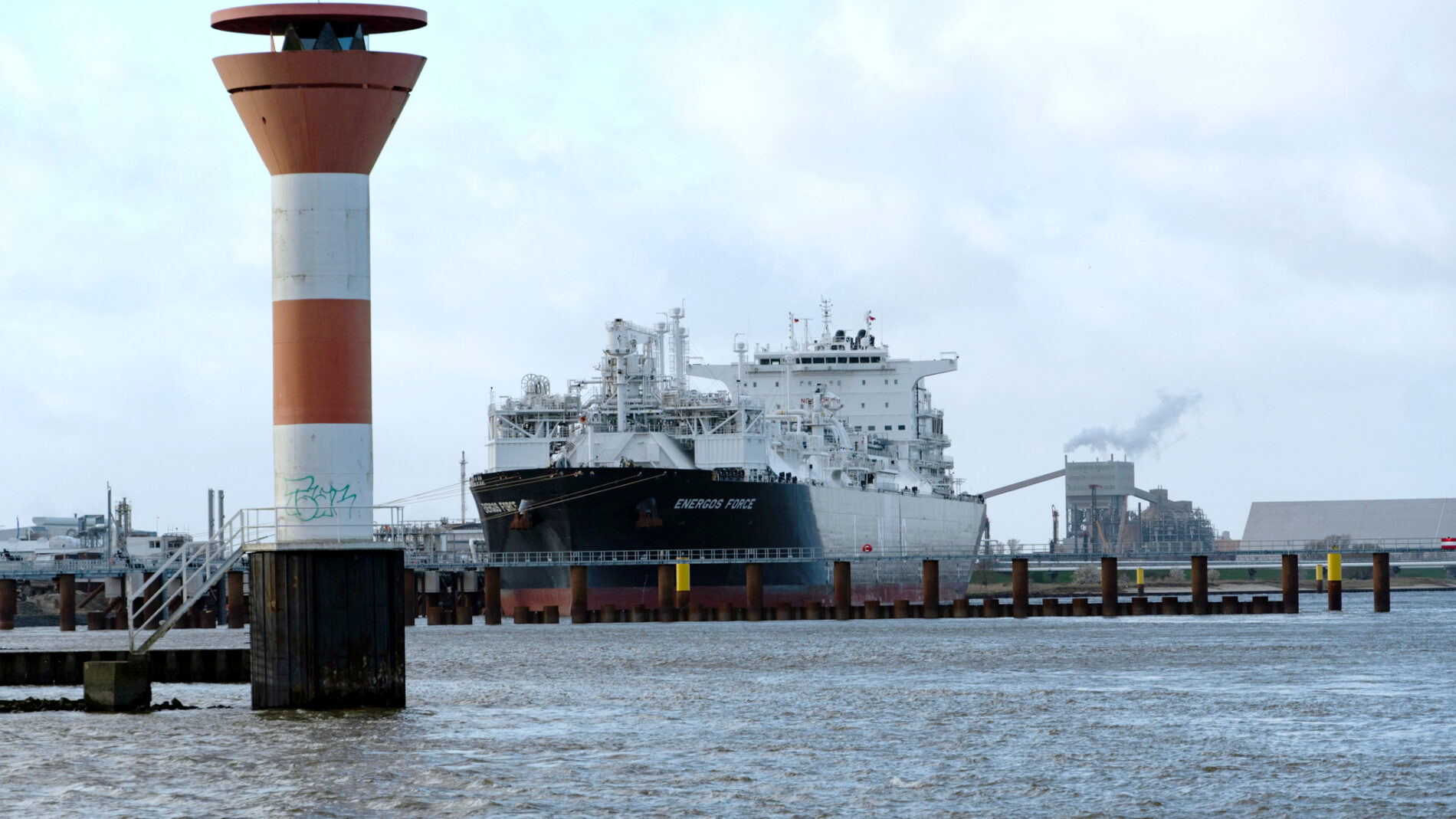
Image: AntonHeiz, CC BY-SA 4.0, via Wikimedia Commons

“We expect the first fully loaded LNG tanker to come alongside in early November,” explained DET head Peter Röttgen. Gas injection would begin at that point. “The road to this stage hasn’t always been easy,” he added.
The Stade terminal was originally scheduled to go into operation in 2024. The berth for the vessel was already complete at the time, and the Energos Force had arrived. However, operations could not commence because further work on the facility was required.
Two additional state-owned LNG import terminals are already operational in Wilhelmshaven, with a third in Brunsbüttel. In addition, the private company Deutsche Regas operates an LNG import facility in Mukran on the Baltic Sea island of Rügen. Last year, LNG terminals accounted for around ten percent of German gas imports.
Environmentalists strongly criticize the continued expansion of LNG import infrastructure. “The federal government must not confuse security of supply with maximizing fossil fuel infrastructure,” stated Sascha Müller-Kraenner, Federal Executive Director of Environmental Action Germany (Deutsche Umwelthilfe). “Security of supply is achieved through reduced gas consumption, renewable energies, energy efficiency, storage, and a diversified energy system—not through ever-increasing LNG supplies and capacity.”
Author: AFP – pe/ilo – Translated by Blackout News
Sources: AFP Press Portal